Know your Foe
The European Rabbit
This time of year with the arrival of spring (at last) you get an increase in the numbers of rabbits that encourage people to pick up the phone and ask for quotes to control their numbers. People often perceive the rabbit population to have just suddenly exploded. By the time the survey is arranged, carried out and agreed on the grass has grown too long to see what’s really going on. Ideally folk should plan ahead of this “bumper time” for rabbits.
The UKs rabbit species, (Oryctolagus cuniculus), have been in the Uk for hundreds of years originally introduced to Britain by the Normans for their meat and fur. During the two great wars they no doubt provided our grandparents with meat for the table too. The have colonised most if not all of the UK since their arrival becoming both an important ecological species and a significant agricultural pest.
Legislation created around the second world war was created to ensure that numbers and their habitat could be controlled to protect land and crops from widespread destruction caused by their extensive and often damaging burrow systems and their insatiable appetite.
When consuming crops (around 1% of the crop per rabbit per hectare is destroyed) reducing winter crop yields by as much as 20%. Economic losses often total more than £100 million a year across the UK, half of which is felt by the farming industry alone.
In forestry, they can strip bark and feed on young tree shoots, preventing regeneration. Excessive grazing can lead to soil erosion and negatively affect biodiversity, although in some ecosystems rabbits help maintain species-rich grasslands, so not all doom and gloom!
In 1953 myxomatosis was introduced which nearly wiped out the total population of rabbits in the UK, since then the disease, which is still prevalent, continues to reappear in different strains.
In the late 1980’s VHD (viral haemorrhagic disease) originally evident in the SW of England has now spread across the UK and most likely accounts for more rabbits than are shot, gassed, netted, trapped, ferreted or hunted.
Over time rabbits, being so populous have developed some resistance to both diseases leading to population recovery in some regions. It goes without saying that you can’t actively use these two diseases to control rabbits in the UK.
They are known to carry ticks and of course they have their own species of flea (Spilopsyllus cuniculi) both of which are the vectors for the spread of myxomatosis.
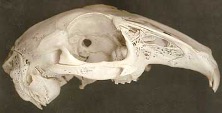
Biologically, rabbits are herbivorous characterized amongst other traits by their continuously growing incisors (before the early 1900s they were classified as rodents) adapted for gnawing fibrous vegetation. They actually differ from rodents as they have an extra pair of “peg” teeth on their upper jaw which separates them from rodent species.
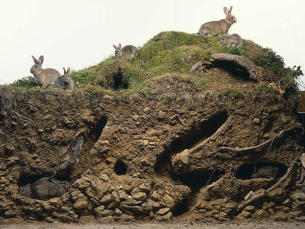
Rabbits are crepuscular (most active at dawn and dusk) which helps them avoid predators such as foxes and birds of prey. They live in social groups with bucks generally adopting a harem system with female rabbits (does), dominant rabbits commonly occupy the centre of their underground burrow systems / warrens. They can range up to 500meters from their warrens making access to their burrows to ferret or gas prohibitive in some circumstances.
Rabbits are highly reproductive and can breed from a young age (around 4 months), producing several litters each year, typically between February and September. Each litter may contain 5–8 young, called kits. With 50 -60 young produced by a single doe each year they can quickly recover from an outbreak of myxy.
Their diet consists mainly of grasses, herbs, and agricultural crops. Rabbits also practice coprophagy/refection, re-ingesting soft faecal pellets (cecotropes) to extract maximum nutrients from their food. This feeding behaviour supports their survival.
They also mark their territories with droppings, normally found on elevated locations such as fallen trees or small mounds on the ground enabling the scent is carried more easily on the wind.
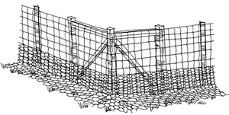
Controlling rabbit populations in the UK requires a combination of methods. Traditional control techniques include shooting and ferreting, both of which are widely practiced and effective for reducing local populations. Trapping is another option, though it must be carried out humanely and checked regularly to comply with animal welfare standards. Gassing (using aluminium phosphide) was widely used to control numbers but more recently the practice has become less common, this could be due to the extensive conditions placed on its use. Other than this the main money is in the exclusion methods, such as rabbit-proof fencing. These can be permanent structures or temporary electric fences. These “permanent” fences are often installed at vast expense then left to fall into disrepair. So it’s worth mentioning this fact to those about to shell out thousands of pounds to protect their assets.
Effective rabbit management typically involves an integrated approach, combining population reduction, habitat modification, and preventative measures. This must be carried out in accordance with UK laws and with consideration for animal welfare, ensuring that control methods are both humane and sustainable over the long term.