Know your Foe
Cockchafer
Melalontha melalontha
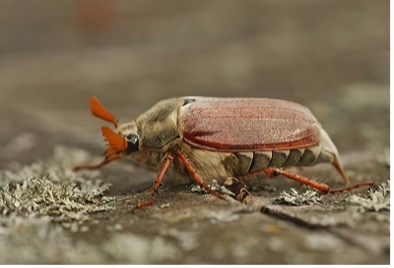
This is my favourite insect. The cockchafer, also known as the May Bug or June Bug, is not a bug at all it is a beetle. These large barrel shaped beetles can appear as early as mid April and as late as mid July. The adults life span lasts up to 5 weeks. The adult beetles are 25mm to 30mm.
Life Cycle
Like all members of the order Coleoptera (Beetles), Cockchafers exhibit complete metamorphosis.
Egg – Larvae – Pupae – Adult
After mating the female lays between 60 and 80 eggs which she buries at a depth about 10 to 20cm in the earth.
4 to 6 weeks later the eggs hatch and the chafer grubs emerge. They then feed on plant roots especially those of oak trees. The larval phase lasts 3 to 4 years until the larvae reach as size of 40mm to 50mm. They will then pupate in early autumn. They over winter in the soil and will work their way up to the surface in early spring.
Significance as a Pest in the UK
From a public health perspective the Cockchafer is extremely low risk and is considered a seasonal nuisance pest especially in the months OF May and June. Our customers will generally mistake them for something else, most usually cockroaches.
They generally come into buildings as it is getting dark as they are attracted to the lights.
Reassurance and education
Explaining the seasonal nature of these insects and that even though they are large that they pose no threat to human health is the most important factor when dealing with cockchafers.
Treatment
Proofing and exclusion is the most effective and environmentally sound way of dealing with cockchafers. All external windows and doors should be fitted with fly screens.
Gaps at the base of external doors need to fitted with bristle stip.
By Proofing and excluding these beautiful insects there really is no need to use any chemical control.