From the Pest Control Library:
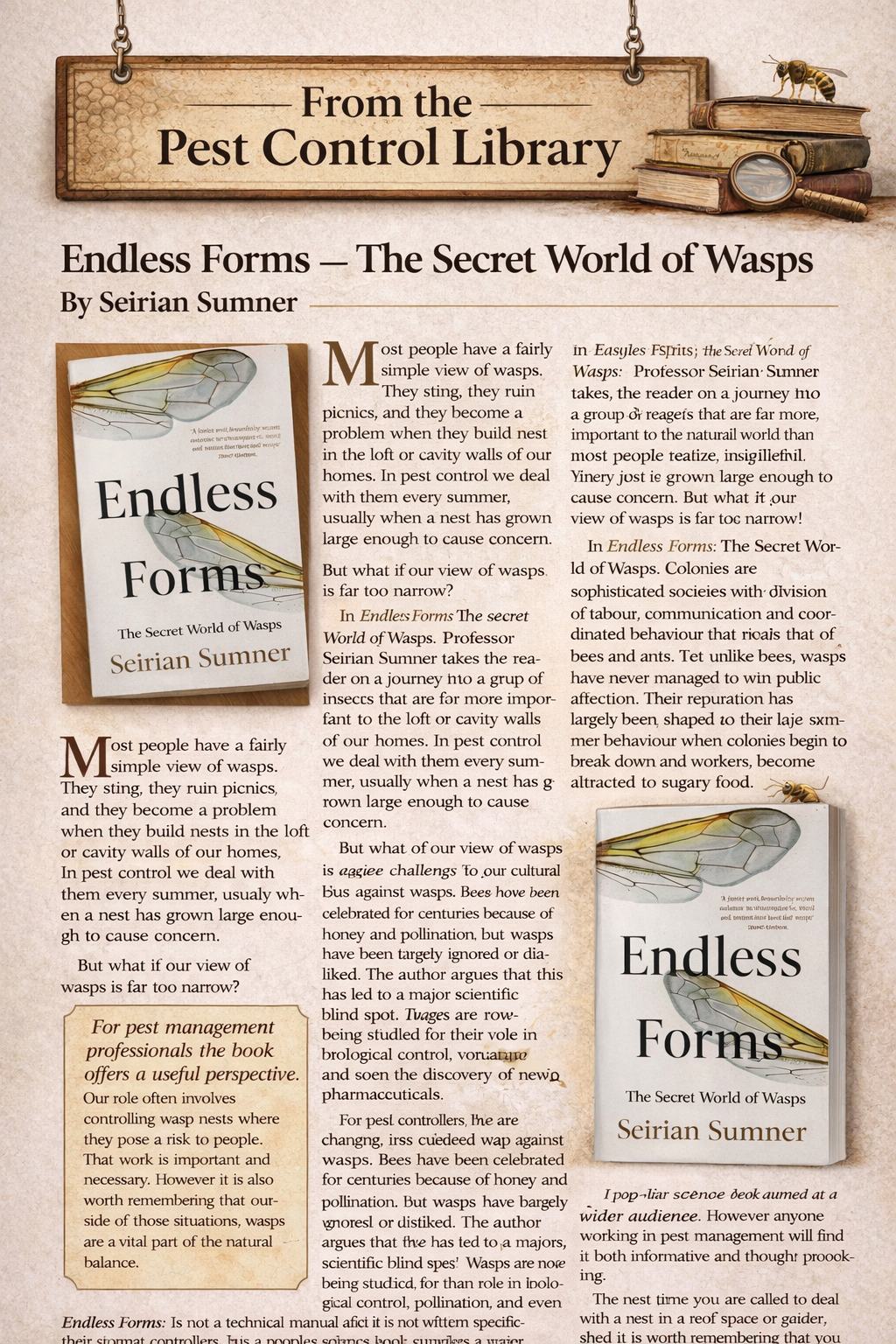
Endless Forms – The Secret World of Wasps
By Seirian Sumner
Most people have a fairly simple view of wasps. They sting, they ruin picnics, and they become a problem when they build nests in the loft or cavity walls of our homes. In pest control we deal with them every summer, usually when a nest has grown large enough to cause concern.
But what if our view of wasps is far too narrow?
In Endless Forms: The Secret World of Wasps. Seirian Sumner takes the reader on a journey into a group of insects that are far more important to the natural world than most people realise. The title comes from Charles Darwin’s famous phrase about the endless forms most beautiful, and it is an appropriate description. There are more than 100000 known species of wasp, ranging from solitary hunters the size of a pinhead to the familiar social wasps that build the nests we encounter in pest control.
What becomes clear very quickly in the book is that most wasps are not pests at all. In fact they are among nature’s most important predators. Many species spend their lives hunting other insects such as caterpillars, aphids and flies. In doing so they act as a vast natural pest control system that operates quietly in the background of ecosystems all over the world.
For pest controllers this is an interesting reminder that the insects we deal with professionally are often only a tiny fraction of the wider picture. The common wasps that cause problems in the UK, such as Vespula vulgaris and Vespula germanica, are just two species in an enormous and remarkably diverse family.
Sumner also explores the intelligence and complexity of social wasps. Colonies are sophisticated societies with division of labour, communication and coordinated behaviour that rivals that of bees and ants. Yet unlike bees, wasps have never managed to win public affection. Their reputation has largely been shaped by their late summer behaviour when colonies begin to break down and workers become attracted to sugary food.
Another interesting aspect of the book is its challenge to our cultural bias against wasps. Bees have been celebrated for centuries because of honey and pollination, but wasps have been largely ignored or disliked. The author argues that this has led to a major scientific blind spot. Wasps are now being studied for their role in biological control, pollination and even the discovery of new pharmaceuticals.
For pest management professionals the book offers a useful perspective. Our role often involves controlling wasp nests where they pose a risk to people. That work is important and necessary. However it is also worth remembering that outside of those situations, wasps are a vital part of the natural balance.
Endless Forms is not a technical manual and it is not written specifically for pest controllers. It is a popular science book aimed at a wider audience. However anyone working in pest management will find it both informative and thought provoking.
The next time you are called to deal with a nest in a roof space or garden shed, it is worth remembering that you are dealing with just one small corner of a much larger and fascinating world.