Know your Foe
The Oriental Cockroach (Blatta orientalis)
NPTA Technical Manager
History and distribution
The Oriental cockroach (Blatta orientalis) has been a recognised pest in the UK as well as the rest of the world for centuries. Like many other species of cockroach now established in the UK the origins can be traced back to Central Asia with trade and human migration over the centuries spreading the populations. The Oriental cockroach or “bo” as it is sometimes referred to is particularly well adapted to cooler climates and can survive lower temperatures than many of its tropical relatives There is a close link with the Industrial Revolution too with expanding cities and the building of underground sewer systems providing the conditions they can thrive in. Classically this cockroach would infest older established buildings (like hospitals, factories, prisons, old tenement blocks etc) taking advantage of the old-fashioned style of heating systems, i.e. central boiler rooms or houses feeding superheated steam through asbestos insulated iron pipes laid in heating ducts that would connect each building on site and thus enable the spread of cockroaches to every building therein. That’s where I first came across them, the old asylums, hospitals and the like. Generally avoiding very hot and dry environments they can easily exist in damp, cool environments too such as basements, drains, sewers, and service ducts, London has them in the drains which I know for a fact so there’s every chance other cities will too. They aren’t really spread by humans the way German cockroaches are, they don’t harbour in the same places that would enable them to be easily transferred from one place to another, if you have an infestation of bo’s chances are they’ve been there a few decades so you can’t blame the current occupants. They are a significant public health and nuisance pest because they can easily spread microorganisms and dangerous pathogens from their often-unsanitary habitats.
Biology and identification
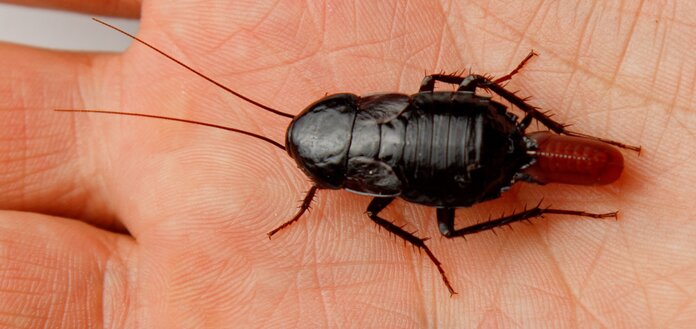
Adult oriental cockroaches are among the largest domestic cockroach species, measuring 20–30 mm in length. Their bodies are broad, flattened, and glossy dark brown to almost black. Antennae are long and whip like and cerci extend from the rear of the abdomen. When they emerge from their ootheca they are much lighter (almost golden in colour) and turn darker as they mature through their moults. Their legs are covered with spines that enable rapid movement across rough surfaces, they can easily climb rough surfaces and in the past, I have found them ten stores up a building following various risers in search of food.
Male characteristics
Adult male oriental cockroaches display wings that cover about three-quarters of the abdomen, so they are easily recognisable. NOTE: Nymphs and females don’t share this characteristic. Despite having wings, they can’t fly, in fact the only cockroaches I have seen fly in the UK are brown banded and Australian cockroaches. It’s a weird phenomenon when it happens as it goes against the grain so to speak as they normally run away from you.
Female characteristics
Females are broader and heavier-bodied. They have small “wing pads”, known as vestigial wings, which do not extend beyond the thorax. Their rounded abdomen is noticeably wider than the males, particularly when carrying developing ootheca. A female cockroach can produce 5-6 ootheca in her lifetime once mated.

Life cycle
Like all cockroaches their lifecycle consists of an incomplete metamorphosis, they emerge from ootheca and moult their way through to adulthood. Breeding generally takes place above 10o C.
Egg stage (ootheca)
After mating, the female produces an ootheca the same colour as herself measuring approximately 8–10 mm long. The ootheca normally contains 16 eggs arranged in pairs.
Unlike German cockroaches, which carry the ootheca until just before hatching, oriental cockroach females deposit it in a sheltered, humid location. Typical deposition sites include cracks in walls, beneath debris, inside wall voids, in or near drains. The egg case absorbs moisture from the surrounding environment, making humidity essential for successful development.
Depending on temperature, ootheca hatch in 6-12 weeks, longer if temperatures are cool. I have seen several hundred deposited in the same location, looking like a pile of coffee beans!! A ticking time bomb if ever I saw one. That was above the ceiling of an old boiler room, I saw what looked like a pile of coffee beans on the floor, looked up and saw they had fallen out of a crack in the ceiling..
Nymph stage
As I mentioned earlier newly emerged nymphs are much lighter in colour than their older siblings, eventually they become the classic brown/black colour as they grow into latter stage nymphs and adults. .
Nymphs undergo 7–10 moults over 6–12 months, depending on food availability and environmental conditions. Growth is much slower in cooler environments, some insects taking up to 18 months to mature.
Adult stage
Once adults reach maturity they typically live 3–6 months. A female producing 5-6 ootheca during her lifetime can potentially result in over 80-100 offspring under favourable conditions. Population growth is much slower than that of German cockroaches, but infestations can still become substantial. Many years ago whilst inspecting and treating the under-crofts of an old hospital I came across a small alcove close to where one of the patients was feeding the feral cats on site, the sheer number of cockroaches couldn’t be calculated, numbers well over a couple of thousand would be my guess. I stood there looking at them, four inches deep covering the floor, walls and ceiling of this ten-foot-deep alcove. I had my B&G 5 litre sprayer with me, when I pulled the trigger they erupted out of their harbourage like something out of a horror movie, still makes me shudder today.
Harbourages
Talking of harbourages, Oriental cockroaches prefer cool, dark, humid places with temperatures between 20–29°C and high relative humidity. They are strongly associated with water sources and rarely thrive in dry environments. Harbourages often exist near a food source, so kitchens are often targeted, even pigeon roosts where the food source is the guano. As mentioned above, the cats were being fed outside an opening to the under-croft, the cockroaches found the food source and stayed there.
Common harbourages include:
- Sewer systems and inspection chambers
- Floor drains and grease traps
- Basements and cellars
- Pipe ducts and service voids
- Boiler rooms and plant rooms
- Risers
- Wall cavities
(They infect the structure of the building rather than things in it, German cockroaches on the other hand will infest kitchen cupboards, the workings of boilers, various “white goods”, radios, microwaves etc, so treatment is very different)
During daylight they remain hidden, emerging at night to forage. Their tendency to aggregate is influenced by chemical cues in their faeces causing large numbers to occupy the same shelter. Night inspections are the classic way to discover what’s going on with an Oriental cockroach infestation though traps can also be of help.
Disease and public health importance
Oriental cockroaches are mechanical vectors, meaning they transport pathogens externally on their bodies and internally within their digestive tract, picking up bacteria from contaminated environments including sewage, refuse, faeces and other decaying organic matter before walking across food preparation surfaces. This behaviour allows them to spread microorganisms onto utensils, food, and packaging as well as the contamination risk from their moults too. Research has demonstrated that cockroaches can harbour antimicrobial-resistant bacteria, increasing concern in hospitals and food-processing facilities. However, they should be regarded as potential mechanical carriers rather than primary biological hosts of these pathogens.
Allergens and human health
Impacts on health can come from cockroach allergens rather than infectious diseases. Proteins found in saliva, faeces, cast skins, and dead bodies become incorporated into household dust. Children living in cockroach-infested housing have been shown to experience higher rates of asthma symptoms, particularly in densely populated urban areas. This could affect triaging works under Awaab’s Law for example.
Behaviour
Oriental cockroaches are primarily nocturnal. They possess excellent tactile and chemical sensing abilities using their antenna. Water is more important than food, adults can survive approximately a month without food but only around two weeks without water. Cockroaches are known to be cannibalistic when food sources dwindle.
Integrated control considerations
Effective management focuses on eliminating the conditions that support survival. Moisture control may be difficult to harness but the food source may be, if there are pigeons roosting nearby, address the issue, if its food and grease left out, address that, followed by increased hygiene regimes and finally exclusion. Repairing leaking pipes, improving drainage, sealing manhole covers and gaps around service entries, reducing clutter greatly reduce available harbourages. Night inspections are invaluable in determining the potential harbourages as you’re unlikely to find them in the daytime. Use traps to help pick up activity, then follow up with a night visit. I’m not a great believer in insecticidal gel baits when used against bo’s, they can be useful where residual insecticides are difficult to apply but the method I would invoke would be the treatment of all potential harbourages with residual insecticides, dusts are particularly useful in getting lethal control into void areas that would otherwise be inaccessible. Insecticides containing insect growth regulators are also a good method of gaining control. You have to stand back and think where they are hiding, having knowledge of how the site or building is put together helps enormously too, so if there is anyone around to explain where any ducting is, drains, under-crofts etc then use their knowledge.
I have succeeded in almost clearing sites of these insects after years of infestation, but it is a long-term operation, you think they’ve gone then the ootheca hatch. We all know the hatching times can throw a spanner in the works.
Summary
A resilient pest species distinguished by its preference to harbour in often inaccessible damp environments, slow development, and dark, glossy appearance. Its life cycle revolves around the production of protective ootheca which can sit tight for many months without hatching fooling you into thinking you’ve got rid of them. Males possess functional-looking wings while females only have wing pads. The nymphs can take over a year to mature dependant on temperature. Although they do not transmit disease biologically, their nocturnal roaming nature makes them an important mechanical vector of bacteria, parasites, and allergens as well as creating a contamination risk in food production and storage. Understanding their biology and harbourage preferences is fundamental to successful treatment, subsequent monitoring and long-term control.