Know your Foe
The Asian Hornet (Vespa velutina)
Duncan Bosomworth, NPTA Technical Manager
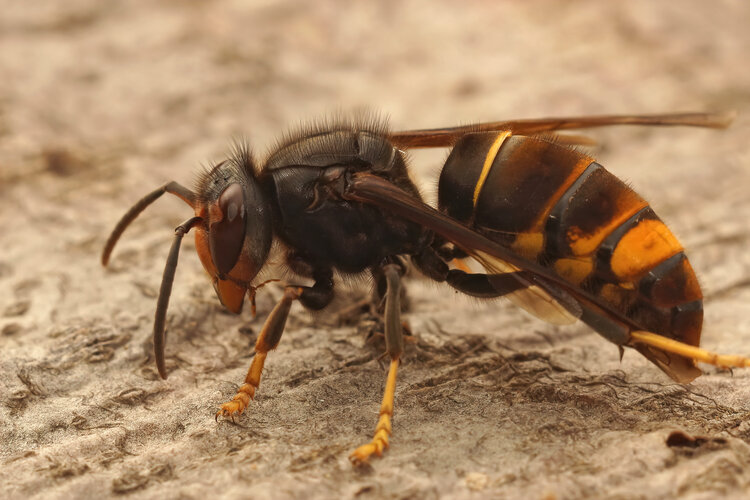
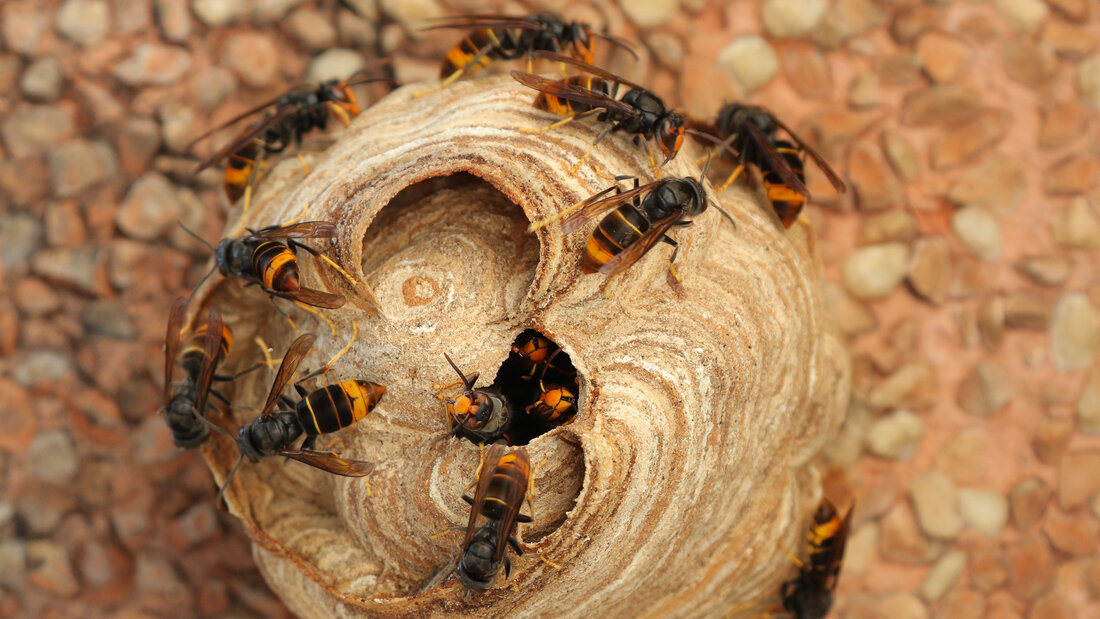
The Asian hornet, also known as the yellow-legged hornet, is an invasive non-native species that poses a significant threat to honeybees and other pollinating insects in the United Kingdom. Native to Southeast Asia, it was accidentally introduced into Europe in the early 2000s through imported goods and has since spread across several European countries. Although established in parts of continental Europe, the UK through the APHA has so far prevented widespread establishment through rapid detection, surveillance, and destruction of nests.
Like other hymenoptera, Asian hornets emerge in the spring when queens emerge after overwintering. They initially construct a small primary nest like our native species of wasps and hornets, then secondary nests are created, traditionally these are normally high up in woodland canopies, well out of sight and reach of most people. Nests can also be built in other locations so don’t always assume that they are always located in trees. The nests can get reasonably large, 50cm by 80cm, with an entrance to the side rather than at the base which is common with large wasp nests. The life cycle otherwise generally mimics our own wasp and hornet species, with the nest growing throughout the year.
By late summer and early autumn, the colony reaches its maximum size. At this stage the colony begins producing new “ virgin” queens and together with the arrival of male hornets breeding soon takes place. The newly mated queens disperse, eventually finding their own place to overwinter, temperatures eventually fall off and the colony breaks down and dies, leaving the queens produced in the autumn to continue the cycle year on year.
The spread of Asian hornets in the UK has shown that the south coast is (not surprisingly) the main stepping stone for these insects, tracking has also shown that shipping arriving at some of our English channel ports is also how the UK is under attack. Natural dispersal occurs when newly mated queens fly several kilometres before establishing their nests. However, long-distance spread is often linked to human activity, including the transport of vehicles, caravans, freight, garden materials, and commercial goods. This combination of natural movement and accidental transportation means isolated incursions can occur many miles from existing populations.
The greatest concern surrounding Asian hornets is their impact on honeybees, but other pollinating insects get predated on too which could potentially affect much wider ecosystems and pollination vital to food chains.
Honeybees form a significant part of the hornet’s diet, particularly during late summer when colonies require large amounts of protein to feed developing larvae. Asian hornets frequent the area immediately outside beehives and honeybee nests looking for a meal, capturing worker bees in flight emerging or returning to their nest. The hornets are mainly interested in the protein-rich thorax which they feed to their young. Persistent predation places enormous stress on honeybee colonies which in severe cases, can cause the colony to collapse.
Asian hornets are generally less aggressive towards people than many expect. They don’t normally attack humans unless they perceive a direct threat to their nest. NOTE: As their nests are frequently at great height this shouldn’t surprise anyone. However, nests can be defended aggressively if approached closely, particularly during late summer when colony populations are largest. The sting is comparable to that of other social wasps or hornets. Most people experience temporary pain, swelling, and redness. Individuals with allergies to wasp stings may however suffer severe allergic reactions, including anaphylaxis, which would require immediate emergency medical treatment. Anyone discovering a suspected nest should keep well away and think twice about treating it themselves. I have personally met the first reported victim of an Asian hornet attack in the UK and he reacted very badly to the sting, but as we all know the reaction can vary from person to person, this particular person lost consciousness from the sting from an Asian hornet.
The United Kingdom has developed a comprehensive surveillance and response network to prevent Asian hornets from becoming permanently established. The National Bee Unit (NBU) operates on behalf of the UK Government investigating reports of suspected Asian hornets, confirming identifications, locating nests, and helps to coordinate eradication activities. Modern tracking techniques have become increasingly sophisticated. Once individual hornets are captured, they can be marked with small coloured tags or paint to distinguish them from other insects. Inspectors observe the direction and timing of returning flights, enabling them to locate nests several kilometres away. In some cases, miniature radio transmitters are attached to foraging hornets, allowing them to locate nests. Thermal imaging drones, visual searches, and field observations are also used to locate nests concealed high within tree canopies or dense vegetation.
The UK’s response also involves the Animal and Plant Health Agency (APHA), which oversees operational activities relating to invasive species and bee health. Scientific support has historically involved the Food and Environment Research Agency (FERA), whose expertise contributed to research, diagnostics, surveillance, and the development of effective management strategies for invasive pests affecting agriculture and pollinators. Today, surveillance, laboratory analysis, and scientific advice continue through collaboration between APHA, the National Bee Unit, government scientists, and research organisations. As a result when there is a confirmed sighting the “kill” rate is generally 100% but can involve several days of tracking and searching before getting a good lock onto the nest.
Public reporting plays an essential role in successful surveillance. Suspected sightings should be reported through the official Asian Hornet Watch app or directly to the National Bee Unit on 0300 3030094 or 07500 891425. Prompt reporting allows inspectors to react quickly, find the nest and destroy it before the season progress’s which reduces the impact of Asian hornets the following year.
Treatment is usually performed during the evening or early morning when most hornets are present within the nest. After insecticide application, the colony is monitored to ensure all activity has ceased before the nest is removed where practical.
One of the main challenges is the sheer height and location of some of the nests making treatment very difficult. I attended a government led meeting years ago to discuss what we could do if and when Asian hornets arrived in the UK.
Insecticide choice was less restrictive than it is now, logistics also came into the conversation, “How do you reach something in the middle of dense woodland in the middle of summer 60’ up in a tree?” was debated for several hours, the use of a shotgun to knock it out of the tree was initially suggested, we laughed then we stopped laughing, not such a bad idea actually, killing off the nest as it hit the ground with insecticide, no working at heights, no cherry pickers crashing their way through protected woods..
There were ideas coming out of France at the same time that showed people using huge telescopic “wands” to do the deed, an idea that caught on over here no doubt!
The UK’s rapid response strategy has so far been highly successful in preventing widespread establishment of the Asian hornet. Continued surveillance, public awareness, scientific monitoring, and swift nest destruction remain the country’s best defence. By understanding the hornet’s life cycle, recognising the threat it poses to pollinating insects, reporting suspected sightings promptly, and having trained authorities to manage confirmed nests safely, everyone can contribute to protecting the UK’s bees, agriculture, and natural environment.