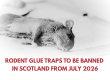
Rodent glue traps – What is going on?
Sophie Thorogood, NPTA Technical Committee
Since the Glue Trap (Offences) Act 2022 came into place, the NPTA has been aiming to help improve the effectiveness and functionality of the legislation. This is a major challenge as whilst the legal use of rodent glue boards is restricted to licensed professionals, there is no restriction on the sale or purchase of rodent glue boards. This means that any lay person with no specialist knowledge or training on the safe and humane use of glueboards, can easily purchase them and use them, either intentionally or unwittingly breaking the law. Indeed, with professionals no longer using them, and so taking longer to eliminate rodents from houses and small businesses, it is possible that amateur use has actually increased.
As professionals we understand that if glue traps are not used correctly the rodent can suffer, e.g. by starving to death over a prolonged period. Not only that, many other animals such as birds, small mammals and reptiles can also be killed if the boards are not positioned in safe locations. Initially the NPTA petitioned to ban the sale of glue traps to those without a license, as this seemed the most sensible solution to stop the glue traps being used inhumanely. However, since the legislation came into place, a plethora of new glue boards, with sufficiently thick adhesive to catch rodents, and looking uncannily similar to rodent glue boards, have appeared on the market labelled as insect traps or pest glue pads.
Many online reviews for these ‘insect’ traps indicate that they are not only used for insects, but also for rats and mice.
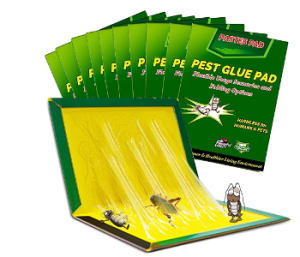
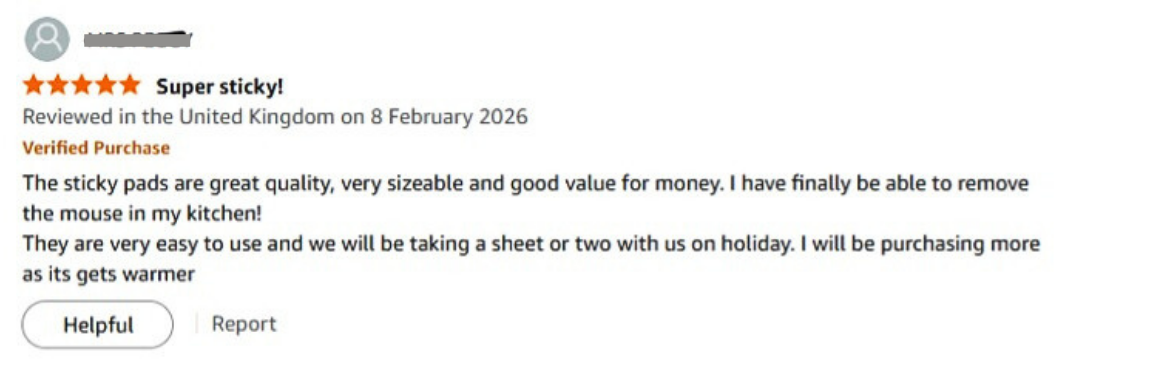
When asked what Natural England can do about the ongoing amateur use, the response was disappointing. They stated that they have limited powers to enforce online sellers to remove the listings; and instead they recommended that when illegal use was found, this should be reported to the Wildlife Crime Unit. But who is going to do that? And the vast majority of them will not be known about by anybody other than the illegal user anyway.
With all this in mind, the NPTAs focus now is to seek extension of the licensing scheme so that the glue traps can be approved for use in more areas. Currently, there are few locations where they are approved, and typically these are based on a high threat of the rodents to public health or safety. Currently, locations such as hospital surgery rooms, inside aircraft, care homes, national food distribution facilities and laboratories may be eligible. Infestations in these locations would have a high impact, but there are many other locations that we believe should be included on the list.
To extend the licensing scheme we are trying to gather case studies to show that without the use of a glue trap, infestations of rodents become harder to manage and therefore there is an increased risk to food and public health. For example, in supermarkets, restaurants and food production and storage facilities where the presence of rodents could lead to food becoming contaminated, to transmission of pathogens and to food wastage. Additionally, the longer the rodents are present in these sites, the more challenging they become to manage, leading to higher use of poisons, which, in turn, increases environmental and health and safety risk. If you can help us by providing evidence comparing the length of treatment time now vs when glue traps were available, we can present this and strengthen our argument to include more locations in the licensing scheme.
In total, Natural England only granted 8 individual licenses and 14 class licenses throughout the whole of 2025. This, we expect, is likely to be a drop in the ocean compared to the number of glue traps that were actually used by unwitting or uncaring amateurs in 2025. By expanding the licensing scheme, it will help professional pest controllers protect clients against rodents, and the risks to health and safety they create. Furthermore, with professionals being able to offer the service, it might also mitigate amateurs resorting to using the traps themselves.